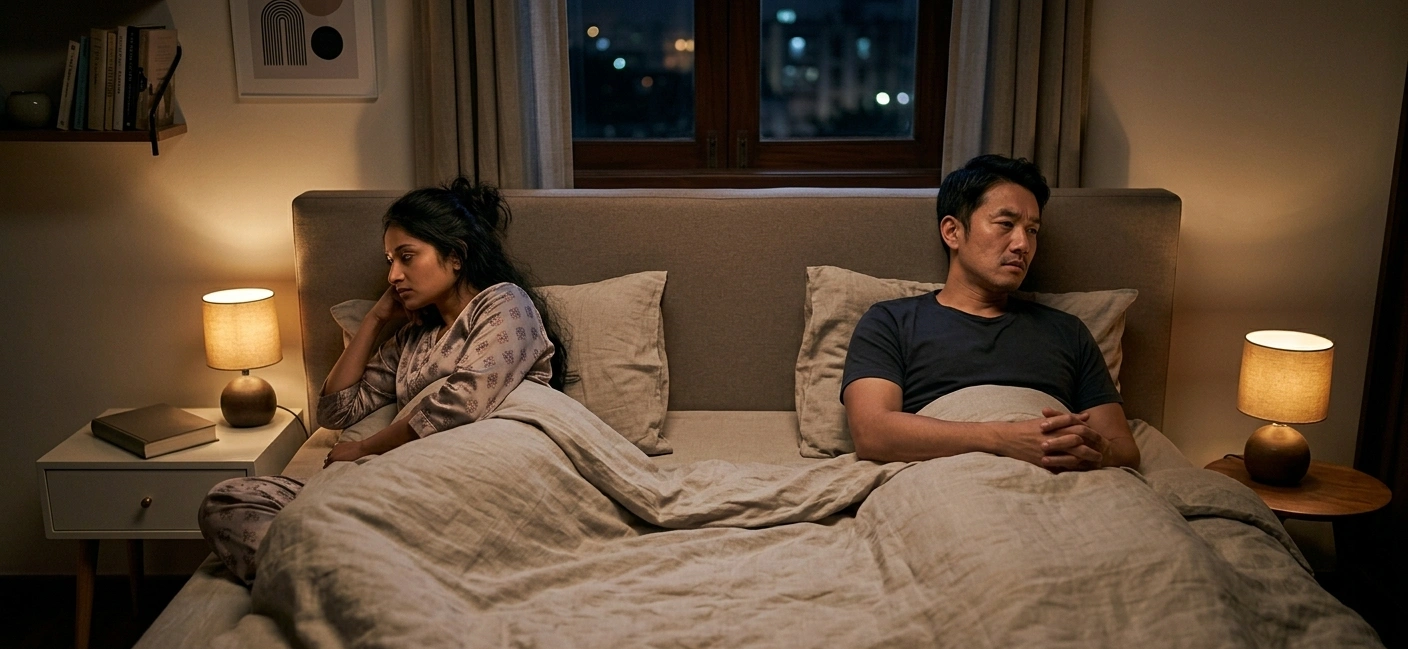
A dead bedroom relationship is one of the loneliest experiences a person can have, because you’re not alone. You’re right there, next to someone, sharing a bed, sharing a life. And still feeling completely untouched. Not just physically. In every way that matters.
The term gets thrown around online like it’s just about sex. It’s not. A dead bedroom is a symptom. Underneath it is usually a story about emotional distance, unspoken resentment, unmet needs, and two people who stopped reaching for each other, slowly, quietly, without either one making a conscious decision to stop.
If you’re reading this at midnight wondering if your relationship is one of them, you’re not broken. And neither is your relationship. Not yet. Maybe not at all.
What Actually Causes a Dead Bedroom Relationship

This is where most articles get it wrong. They list stress and hormones and busyness, and yes, those are real. But they’re surface. The actual causes run deeper:
- Emotional disconnection, physical intimacy almost always follows emotional safety. When couples stop feeling genuinely close, the body quietly follows. It’s not a decision. It’s just what happens
- Accumulated resentment, small injuries that never got addressed. A comment that landed wrong and was never talked about. Needs that were expressed and ignored. That stuff doesn’t dissolve. It calcifies into distance
- Desire discrepancy, one partner wants more, one wants less. Both feel guilty. Neither knows how to talk about it without it becoming a wound
- Identity and body changes, postpartum shifts, aging, weight changes, illness. When someone stops feeling comfortable in their own body, desire often retreats inward before it can reach outward
- Depression and mental health, this one is chronically underacknowledged. Depression kills libido quietly and completely. And the person experiencing it often can’t explain why they’ve withdrawn, which makes their partner feel rejected in ways that compound the problem
- Relationship role collapse, when two people become purely functional with each other, co-parents, housemates, financial partners, the erotic and emotional dimensions just don’t have room to exist
A dead bedroom relationship rarely has one cause. It’s almost always several of these layered on top of each other, over time, until the weight of it just becomes the norm.
Signs of a Dead Bedroom Relationship
Some of these are obvious. Some are quieter and easier to rationalize away:
- Physical touch has almost entirely disappeared, not just sex, but the small stuff too. No hand-holding, no casual contact, no instinctive reaching for each other
- Avoidance around bedtime, one person stays up late, one goes to bed early. The overlap shrinks. Neither one addresses why
- Conversations stay completely functional, logistics, schedules, kids, bills. Nothing personal. Nothing real. The texture of genuine connection is just gone
- Intimacy attempts are met with rejection or deflection, and after enough of that, the attempts stop entirely. Both people are now waiting, both are hurt, neither is moving
- You feel more like roommates than partners, polite, functional, maybe even kind to each other. But not close. Not chosen. Not wanted
- There’s an unspoken thing in the room, both people know. Neither is saying it. The silence about the silence becomes its own kind of weight
The tricky thing about recognizing a dead bedroom is that each individual sign can be explained away. It’s been a busy month. We’re both stressed. Things will pick up. And sometimes that’s true. But when the signs cluster and persist, that’s the relationship asking for attention.
Dead Bedroom and Depression: The Connection Nobody Talks About
This deserves its own section because it’s so frequently missed. Depression and dead bedroom relationships are deeply intertwined, and not always in the direction people assume.
Sometimes depression causes the dead bedroom:
- Low libido is one of depression’s most consistent symptoms, it’s neurological, not personal
- Emotional numbness makes genuine connection feel impossible, not just difficult
- The depressed partner often knows something is wrong and feels enormous shame about it, which makes talking about it even harder
- Antidepressants, while genuinely helpful, can further suppress desire, creating a painful catch-22
Sometimes the dead bedroom causes depression:
- Chronic rejection, even unintentional rejection, erodes self-worth over time
- Feeling unwanted by your partner is a particular kind of loneliness that sits very deep
- The helplessness of not knowing how to fix something important in your relationship is genuinely depressing
According to research from the American Association of Sexuality Educators, Counselors and Therapists, sexual dissatisfaction and mental health challenges are bidirectionally linked, each feeds the other in ways that make intervention without addressing both largely ineffective.
If depression is part of what’s happening in your dead bedroom relationship, for either partner, that needs to be part of the conversation. Not as blame. Just as reality that deserves to be seen.
How to Deal With a Dead Bedroom Relationship
Not a quick fix. There isn’t one. But here’s what actually moves things:
- Name it without weaponizing it,
I miss being close to you” is an opening. “You never want me anymore” is a shutdown. The difference in how you start the conversation determines whether it becomes a bridge or a wall - Get curious before getting hurt,
Withdrawal almost always has a reason. Ask about the reason before responding to the withdrawal. “Is there something going on for you that I don’t know about?” is a genuinely different question than “why don’t you want me” - Separate the conversation from the bedroom,
Trying to have the intimacy conversation in bed, at night, when both people are tired and already in the context that feels loaded, rarely goes well. Take it somewhere neutral - Start smaller than you think
You need to, rebuilding physical intimacy after a long gap doesn’t start with sex. It starts with a hand held. A back touched. Non-pressured, non-agenda physical contact that says I’m here without demanding anything back - Get professional support without framing
It is a last resort; couples therapy or intimacy coaching works best when it’s approached as a tool, not a Hail Mary. The couples who get the most out of it are the ones who come before things feel completely broken
At Intimacy Academy, we work with couples in exactly this place, not at rock bottom, not fine either. Somewhere in the middle, trying to find their way back without a map. That’s exactly where real work is possible.
This Isn’t the End of the Story

A dead bedroom relationship feels like a verdict. Like something has been decided without your input. But it’s not a verdict, it’s a pattern. And patterns can change.
What’s required isn’t passion manufactured from nowhere. It’s honesty. Willingness. Two people deciding that what they have is worth the discomfort of talking about what’s actually happening.
That’s harder than it sounds. And more possible than it feels at 2am when the distance between you seems enormous.
- You don’t have to have it figured out
- You don’t have to know what to say
- You just have to be willing to stop pretending the silence is fine
At Intimacy Academy, we’ve sat with couples in this exact place, quiet, hurting, not sure if it’s too late. It almost never is. Explore our programs for couples rebuilding intimacy here and take the first honest step back toward each other
The 69 Ideas to Spice Up Sex Life ebook isn’t just physical it’s about rebuilding curiosity, playfulness, and desire between two people who’ve gone quiet. A real place to start. Get your copy for ₹599
FAQs
Q.1 What is a dead bedroom relationship?
It’s a relationship where physical and often emotional intimacy has significantly declined or disappeared entirely, not through one decision but through gradual disconnection, unaddressed resentment, and unmet needs that accumulated over time.
Q.2 What are the signs of a dead bedroom relationship?
Physical touch disappearing entirely, conversations staying purely functional, bedtime avoidance, a persistent feeling of being roommates rather than partners, and an unspoken tension neither person is naming directly.
Q.3 What causes dead bedroom depression?
Depression can both cause and result from a dead bedroom relationship. Low libido is a core depression symptom, while prolonged rejection and disconnection create genuine psychological distress, the two feed each other in ways that need to be addressed together.
Q.4 How do you fix a dead bedroom relationship without pressure?
Start with honest, low-stakes conversation away from the bedroom. Rebuild non-sexual physical closeness first, small touch, presence, warmth. Create emotional safety before expecting physical vulnerability to return naturally.
Q.5 Is a dead bedroom always the end of a relationship?
Not at all. Many couples have rebuilt genuine intimacy after years of disconnection, but it requires both people acknowledging what’s happening and choosing to address it actively, usually with some form of guided support.
Q.6 How long does a dead bedroom last before it becomes permanent?
There’s no fixed timeline, but the longer it goes unaddressed, the more entrenched the patterns become. Resentment, avoidance habits, and emotional distance compound over time. Earlier intervention almost always produces better outcomes.
.